| |
| Stretch: |
Chili Bar to Folsom Reservoir |
| Difficulty: |
Class III+ with one IV- |
| Distance: |
20.5 miles, 1 or 2 days |
| Flows: |
rafts 1000 - 5000 cfs, kayaks 800 - 9000, IK minimum 500
|
| Gauge: |
measured as release from Chili Bar dam
(CBR) |
| Gradient: |
23 fpm average (upper 31 fpm, lower 21 fpm) pool and drop |
| Put-in: |
Chili Bar resort near highway 193 bridge, 930' |
| Take-out: |
Folsom Reservoir near Salmon Falls bridge, 440' |
| Shuttle: |
25 miles (1 hour) one-way |
| Maps: |
river permit maps, AAA Lake Tahoe Region,
Topo
upper,
Topo
lower.
|
| Season: |
year round from dam release, might be too high in spring |
| Agency: |
BLM, private, county-issued permit,
guided Whitewater Rafting |
| Notes: |
© 1998, 2000, 2007 Bill Tuthill,
CreeksYahoo |
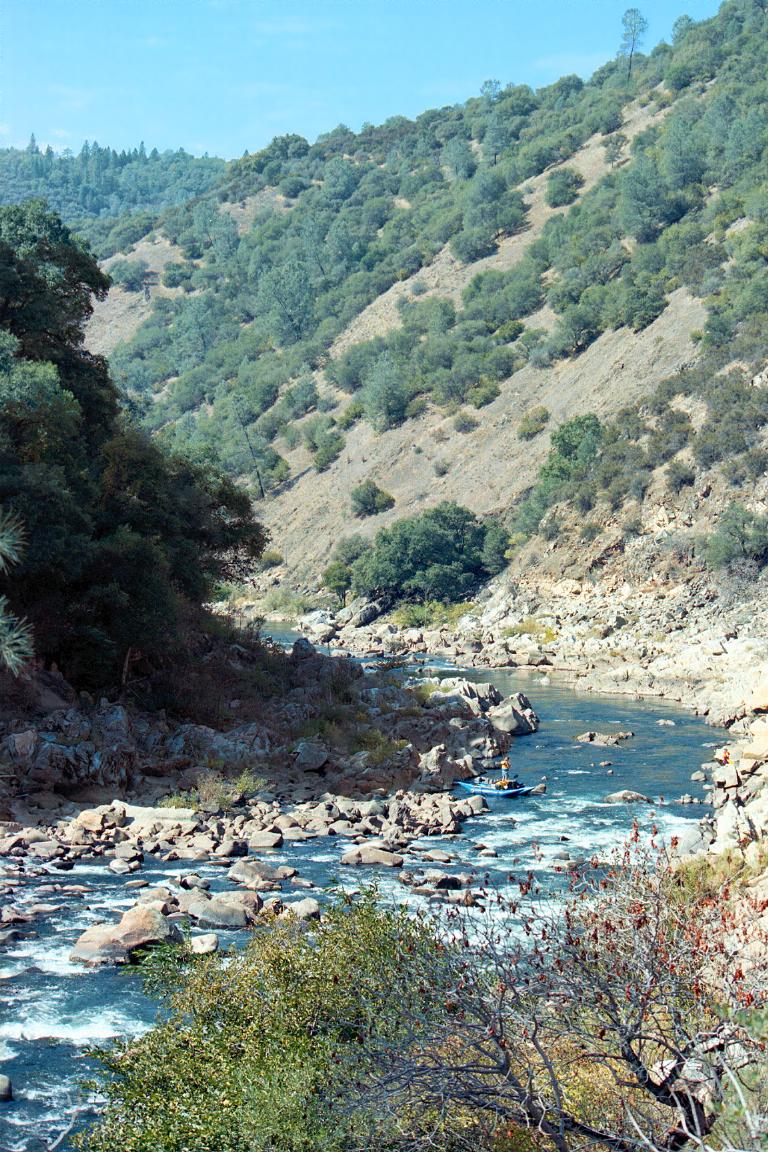
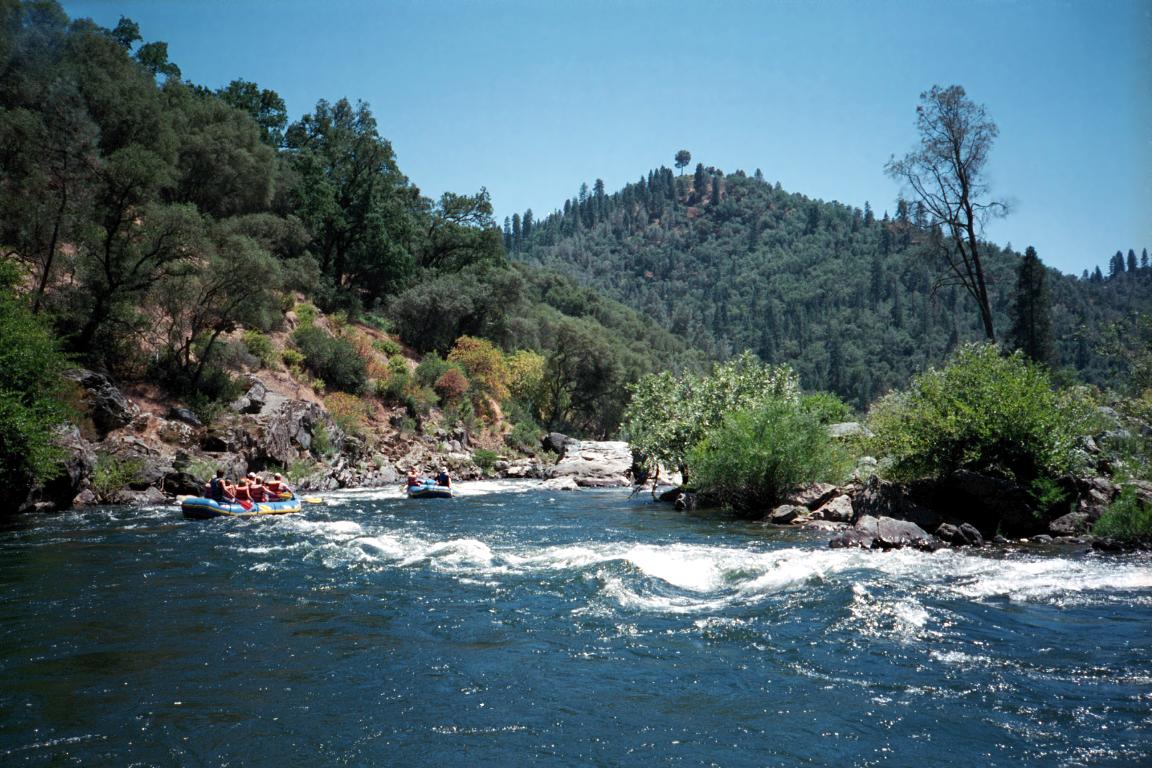
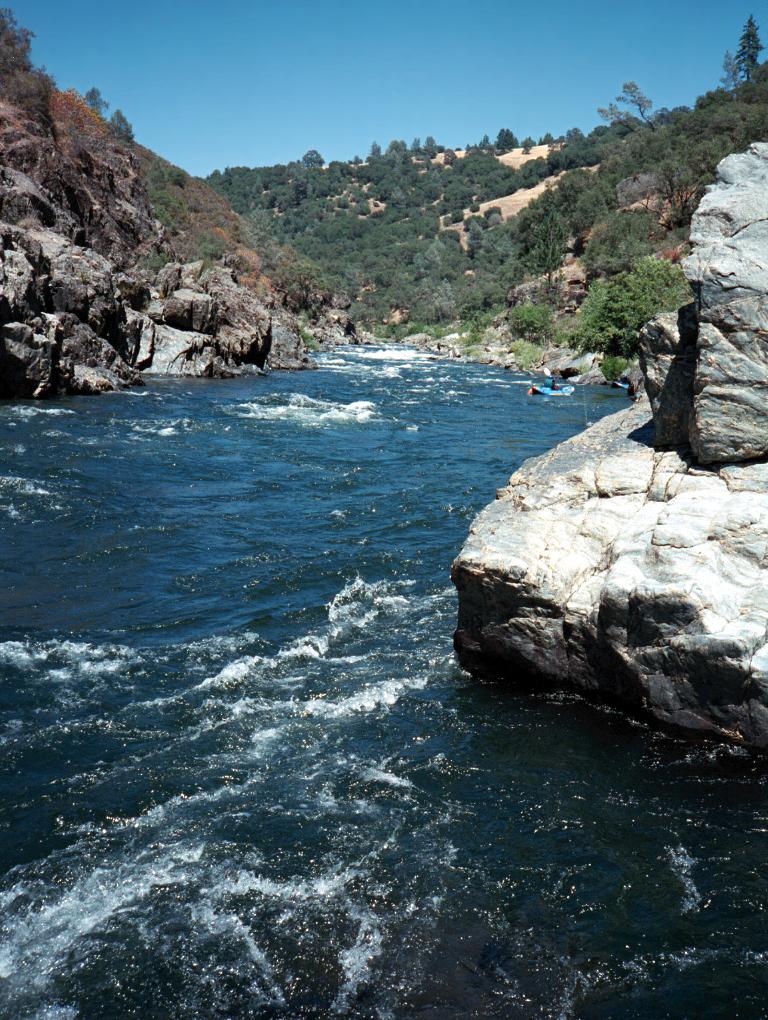
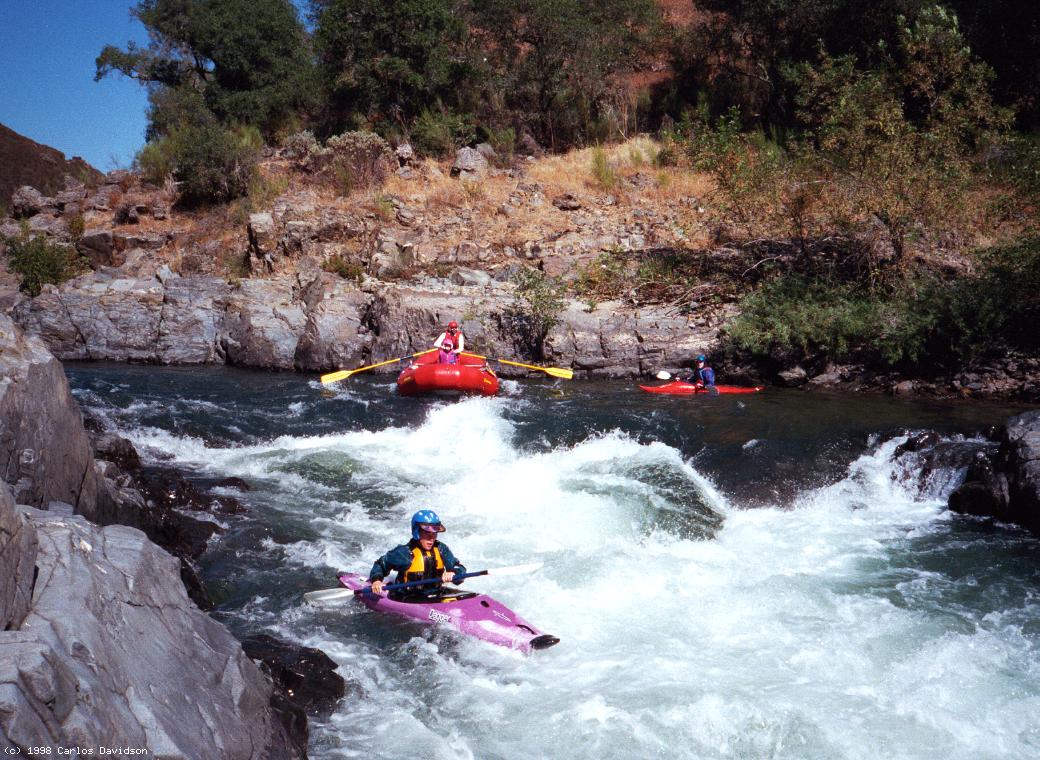
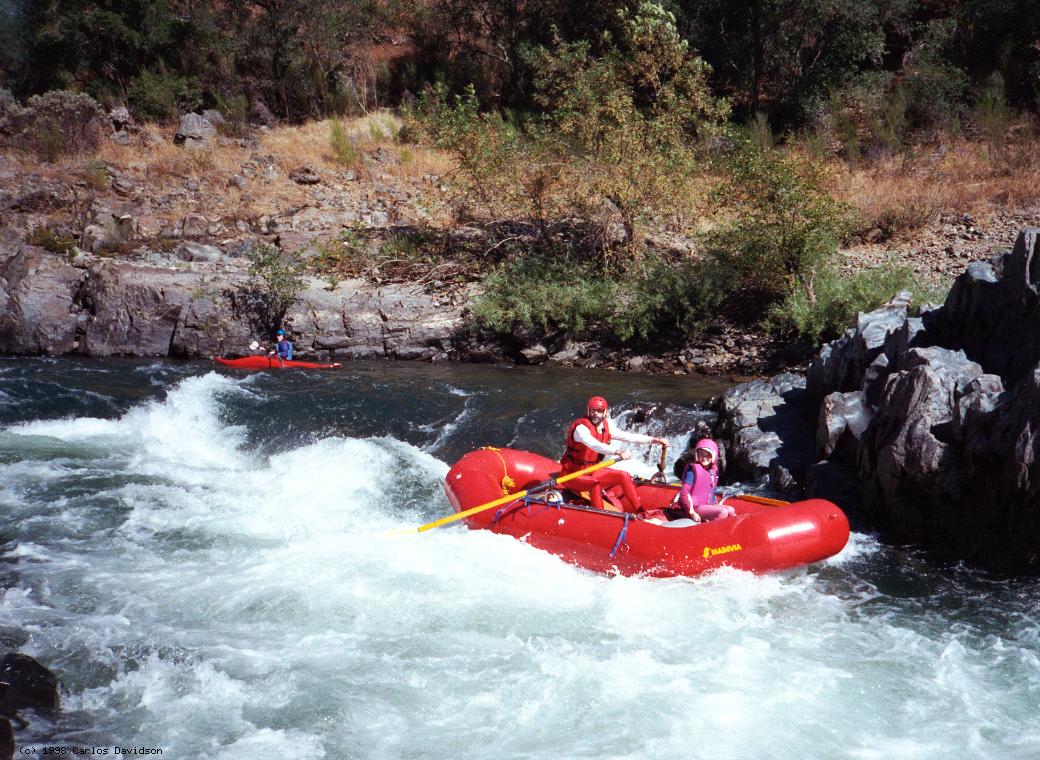
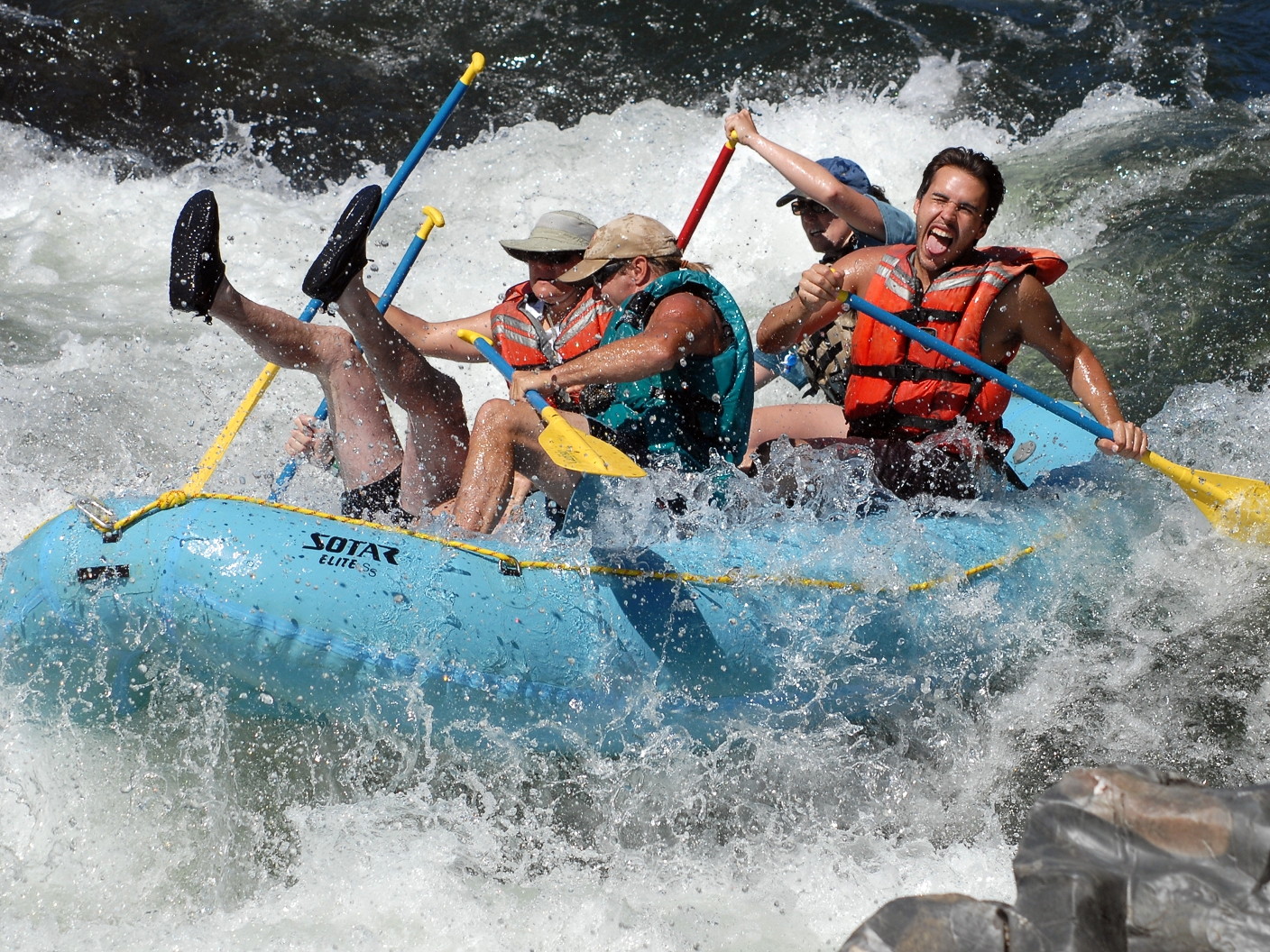
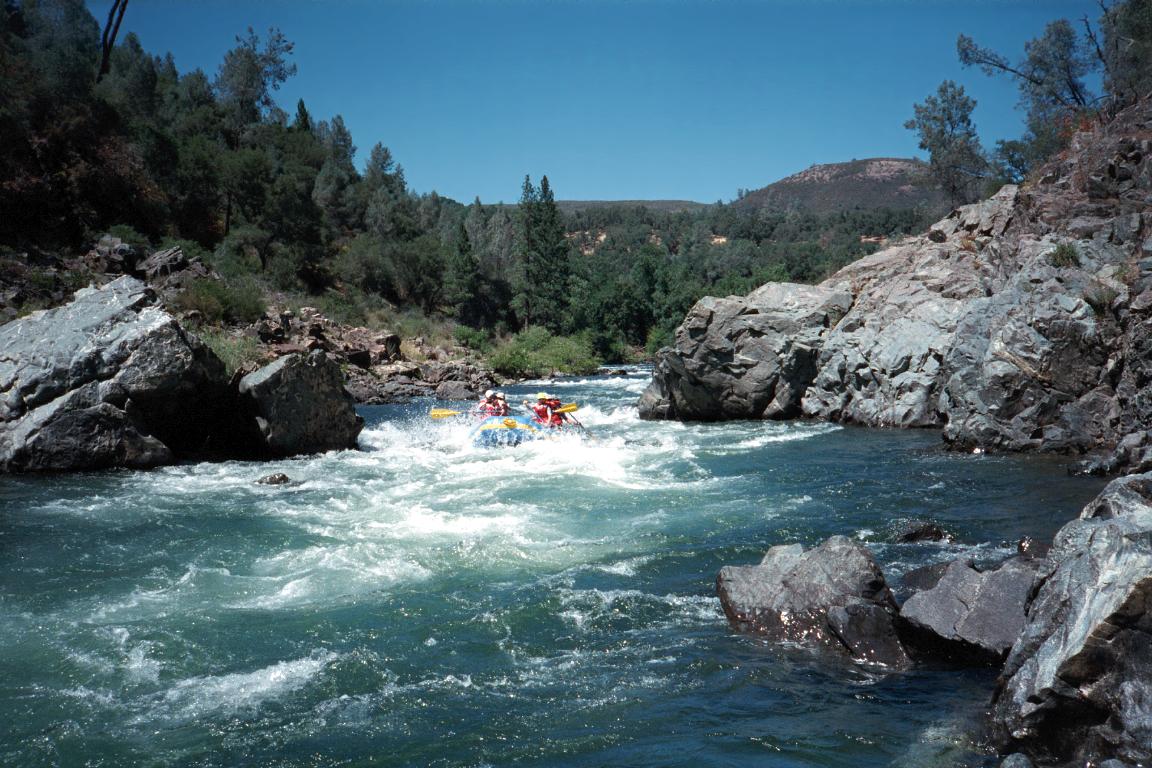
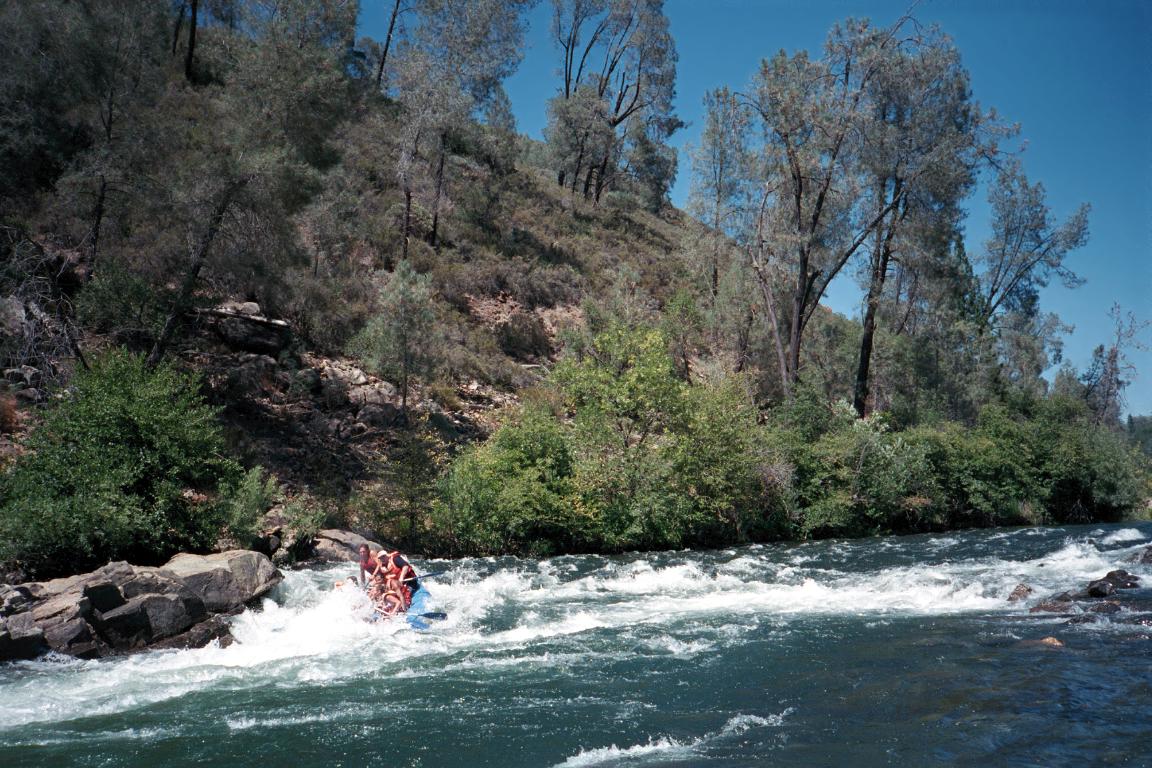
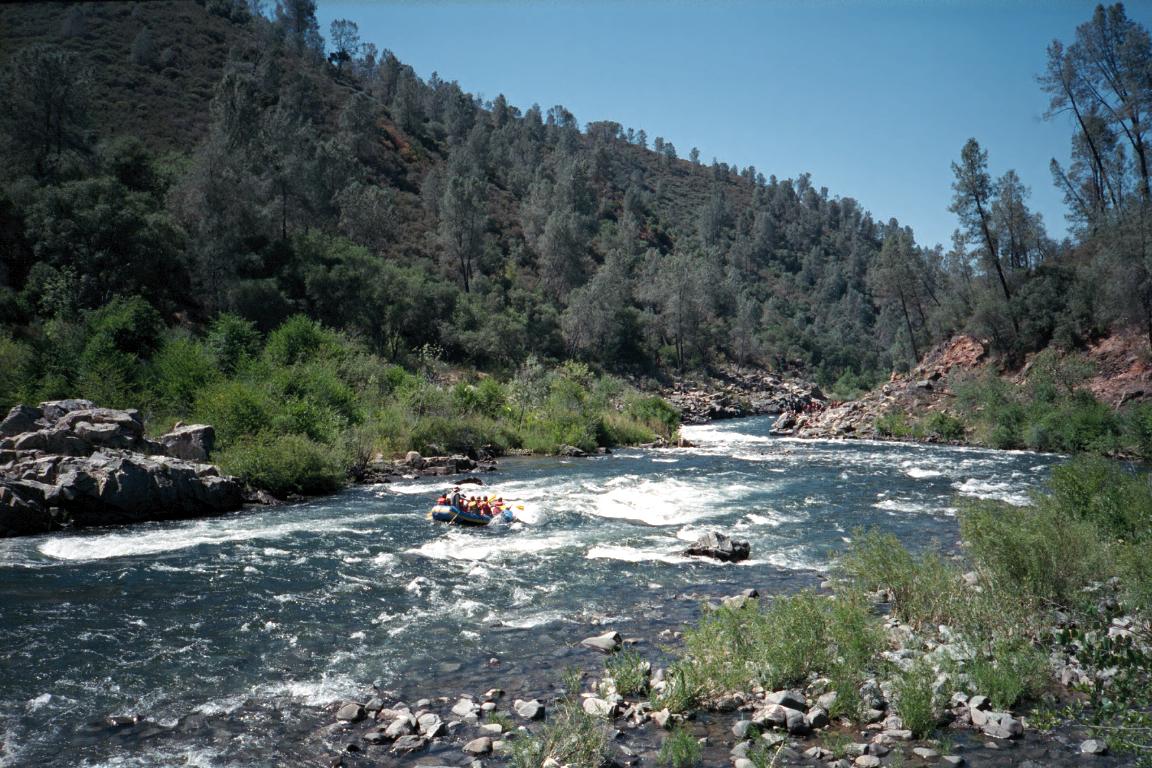
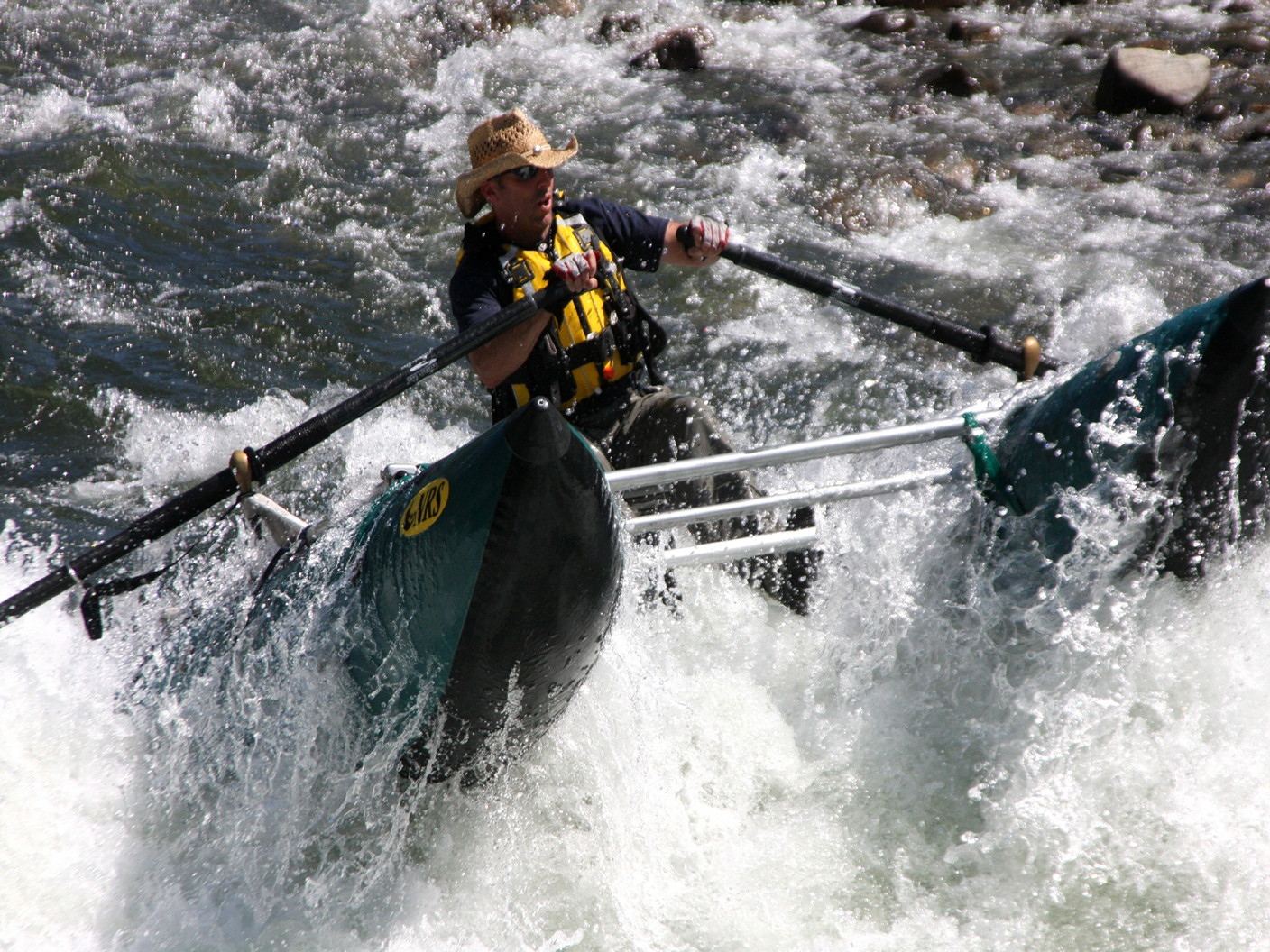
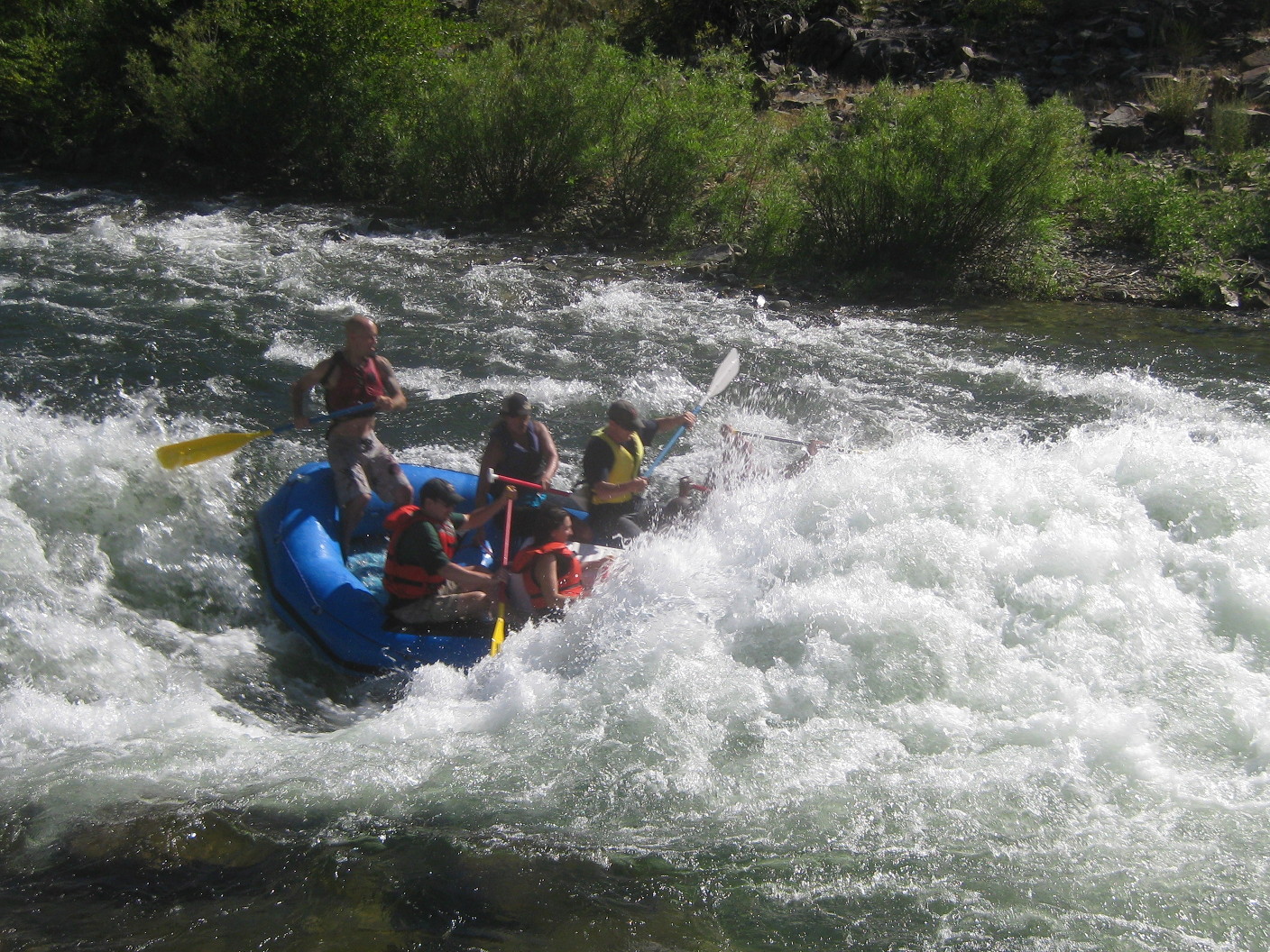
This is California's standard intermediate run
that many boaters run repeatedly and never get tired of running.
Crowds are sometimes a problem on weekends during the summer.
A weekday trip offers more solitude.
The whitewater is mostly class II+ with ten class IIIs,
two class III+ rapids, and one class IV- that repeat customers never scout.
Most commercial outfitters run the lower half on Saturday,
and the more difficult upper half on Sunday,
which is a good strategy.
This river segment contains a lot of fun but not life-threatening rapids,
and can be run almost any day of the year (you may need a drysuit in winter).
The middle third makes an excellent beginner run,
the lower “gorge” makes a good training run,
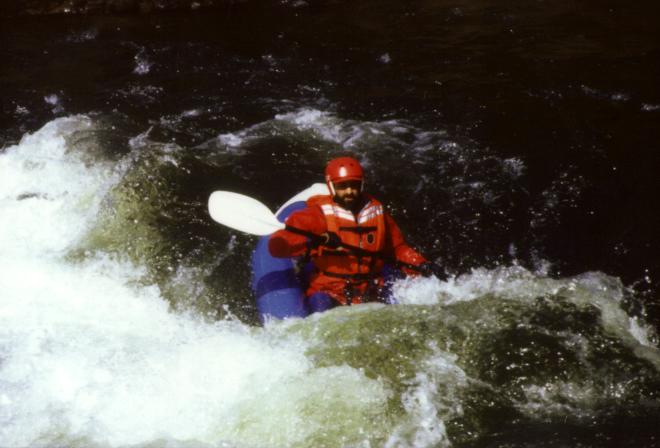
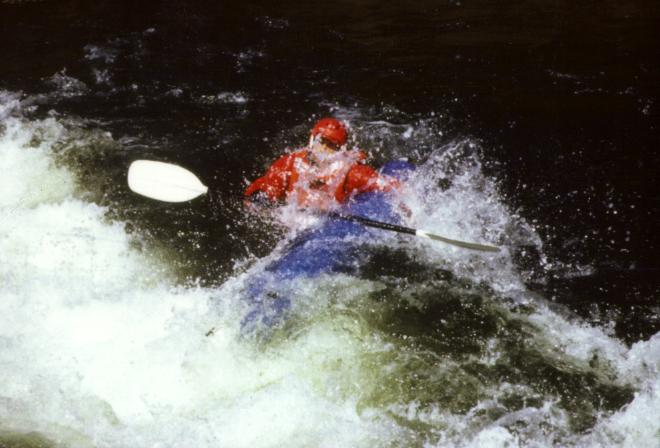
and the slightly tougher upper third has some good surfing spots.
In late September or early October,
the poison oak leaves turn red and provide nice autumn color.
For information about visiting Coloma and environs, see
Coloma.com.
For a list of commercial rafting outfitters, see their
Whitewater Rafting page.
Although the length of 20.5 miles sounds long, it can be boated easily
in one day, except when days are short in the middle of winter.
Car camping is a pain because it is usually hard to find a spot,
and even if you do, it might be dusty and overpriced.
Most boaters choose one of four sections, listed in order of difficulty:
- C to G, class II. Put in at Coloma Lake, take out at Greenwood Creek:
5.6 miles.
- Henningsen Park to Salmon Falls bridge, class III, easy put-in, 12.5 miles.
- Greenwood Creek to Salmon Falls bridge, class III, long carry to put-in,
but (except for vehicle break-ins) free, 9.1 miles.
- Chili Bar to Henningsen Park, class III+, fees at both ends, 8 miles.
However, Uncle David Elliott says you can run this in a single day.
In his immortal words, “it takes just as long waiting
for the water to come up as it does to run the upper half,
and boating is better than sweltering in the sun.”
By getting an early start from Chili Bar,
you can snag a good parking spot,
get a jump on rafters running the upper half,
lag behind rafters running the lower half,
eat a quick lunch, and hopefully reach take-out before sunset.
For inveterate campers who can carry their own gear,
there are some fine campsites on BLM land near a composting toilet
on the right bank at mile 12.1, and again near mile 15.
For wilderness camping, make sure to prepay for a second day of parking!
- mile 0
- Put in near or under the Chili Bar bridge, preferably before 9:00.
Chili Bar Hole provides good surfing at levels around 2000 cfs, but
is rocky at lower flows. Downstream are several easy rapids, two
involving large rocks. A trail follows an old mining road on the
right bank.
- .6
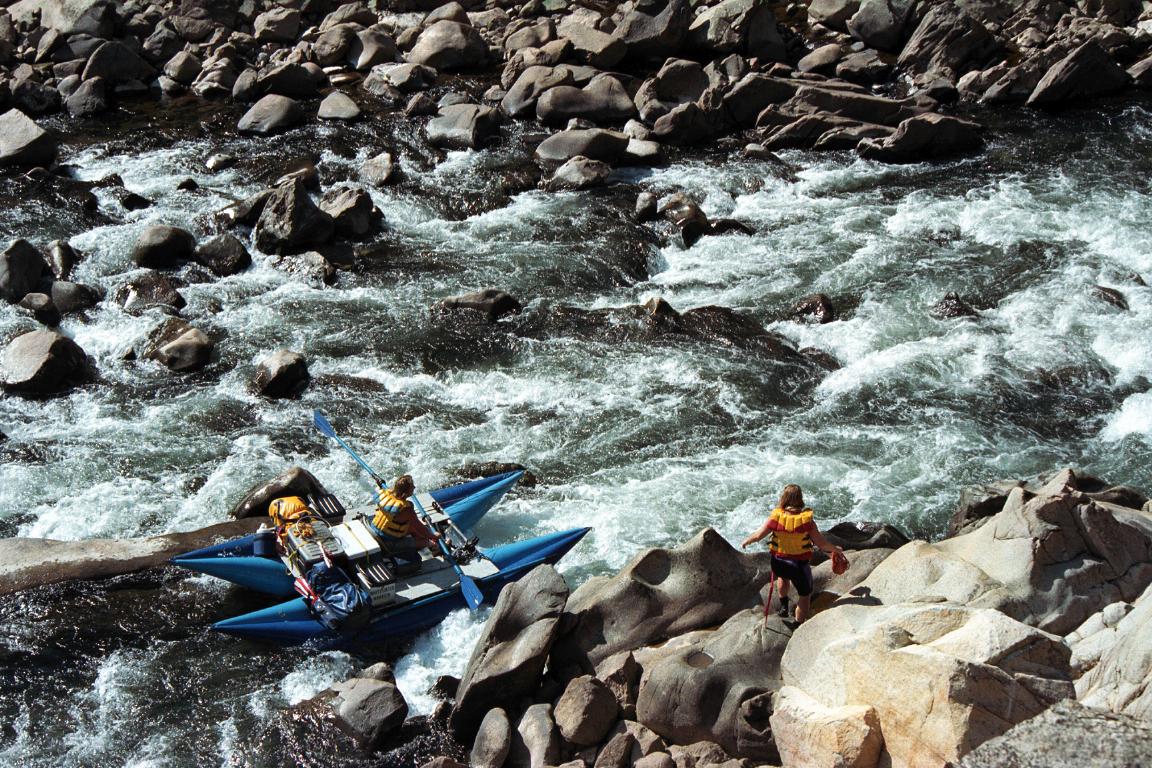
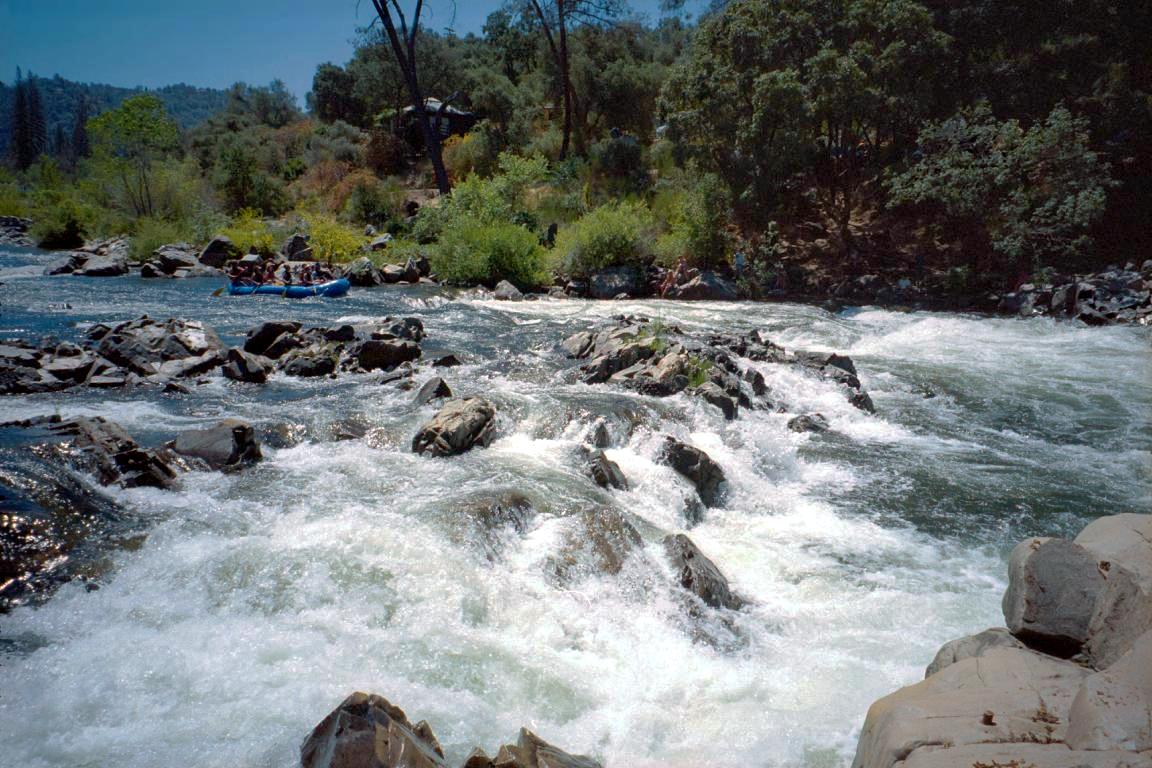
- Meatgrinder, AKA Quarter Mile (class III+). A small diversion canal
removes water on the left, and a large rock is visible there, just
left of center. This is a long rapid (over 1/4 mile, eponymously)
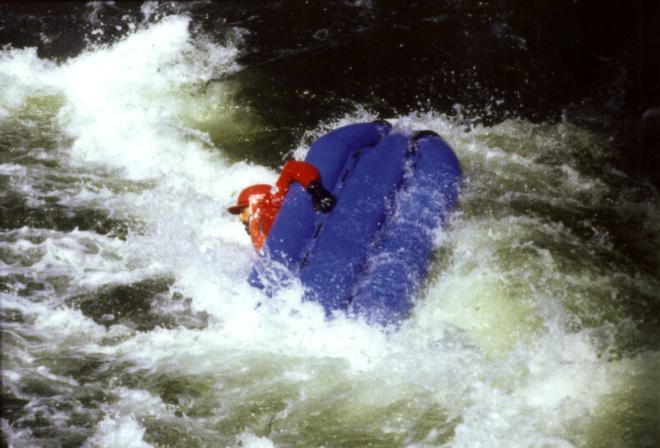
that can cause a bruising or bloody swim if you capsize near the top.
At low flows, the lead-in rapid can be run either left or far right.
Either way, you need to maneuver back to the center, entering the
main rapid about 10 meters from the large rock, slanting left-to-right
thru a slot between submerged rocks. This is an easy move, but
failing to make it can have severe consequences, because the biggest
waves and holes are still ahead. After this, keep your bow into
the waves as the current funnels you towards Rhino rock on the right.
Two rafters died here of foot entrapment within a 3 week period in
1989; the submerged entrapment point was dynamited that fall.
A commercial rafting passenger also died here of foot entrapment
in July 2000. After Rhino rock, overall wave size decreases, and
you can eddy out on the left, or finish the rapid along the right.
Good playspots exist near center.
-
- 1.3
- Racehorse Bend, AKA Sluice Box (class III-). The river curves left
among boulders, then runs into an uptilted slate cliff on the right,
with sharp submerged rocks along the cliff. The safest exit is
towards center. Bad place to swim, perhaps the worst on this whole
run. Big eddy below on the left.
- 1.5
- Maya, AKA Traffic Light (class II+). Choose either a small hole
on the right, or a ledge drop on the left. Big but easily avoidable
holes at higher water (class III above 3500 cfs). Maya is a popular
kayak surfing spot, often with long lines.
- 1.7
- Rock Garden (class II). A maze of small boulders that can help you
improve boat control. At lowest flows (under 900 cfs) it is best
run on the far left, but most of the time you can go anywhere.
- 2.4
- African Queen (class II+). Several willow-covered islands create a
multiplicity of routes. The most common is right almost all the way,
cutting left to avoid a shallow-trap at the end of that channel.
This route passes some nice surfing waves near the second island.
The most fun route is left over a 1 foot falls (not for rafts under
1700 cfs), then center thru a very narrow slot between islands.
The far left channel is boring.
- 2.9
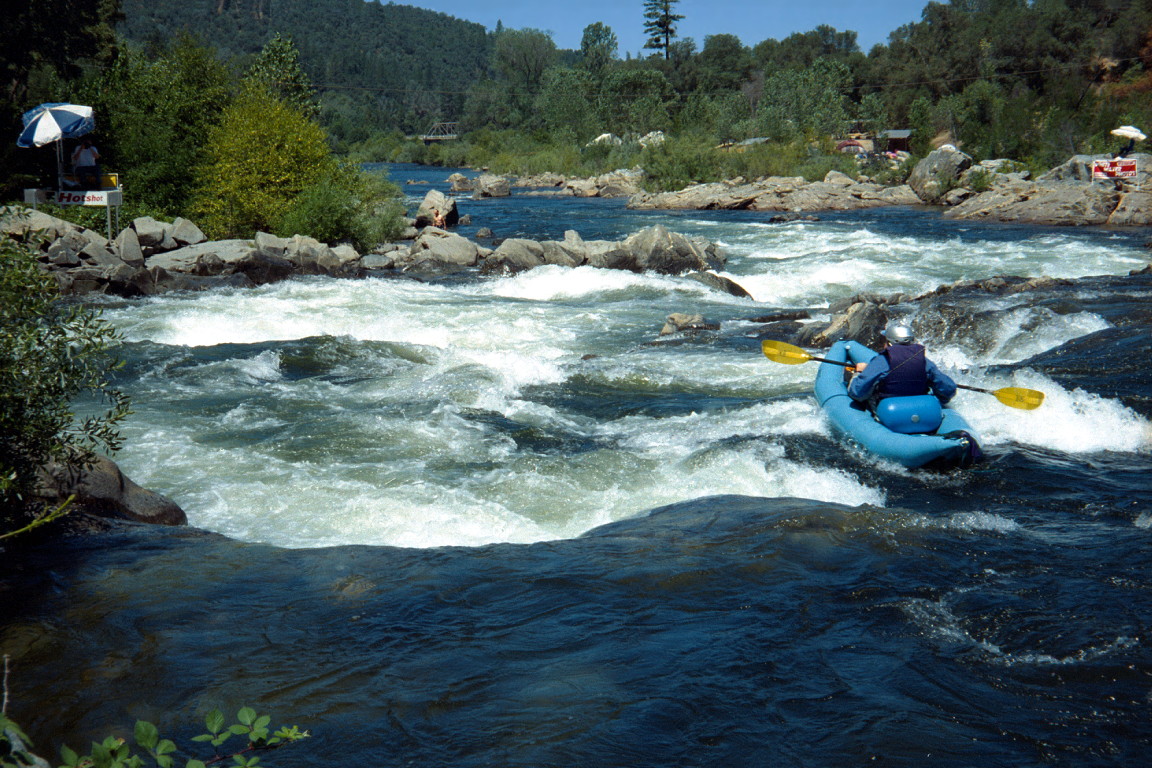
- First Threat (class III). The river enters a boulder garden, then
turns right into a deep hole along a rock outcropping on the left.
The hole makes good advanced surfing, and is flippiest on the left,
but can be mostly avoided by skirting right. Popular with hardshell
kayakers and bodyboarders, surfing contests are often held here.
- 3.2
- Second Threat (class II+). Almost immediately, the river drops
again thru a slot along a rock outcropping on the right. Good
swimmer's rapid with a large eddy below, making it easy to reach
the rock outcropping for repeated swims.
- 3.3
- Third Threat (class II-III depending). Make of this one what you will.
The center is easy and unobstructed, but there are large holes on the
far left halfway down, and on the far right near the bottom. Running
both holes is an advanced maneuver.
-
- 3.7
- Unnamed (class II+). The river slaloms right to left, and enters
a channel on the far left with many barely-submerged rocks. Rafts
often get stuck here. Kayak routes exist to the right.
- 4.0
- Minigorge, class II+. The river enters a miniature gorge in bedrock,
with pleasant waves and rapids. Major squirreliness towards the end.
- 4.3
- Swimmer's Rapid, class II. A boulder bar rapid with big waves, this
is a good place to practice throwbag techniques from the right bank.
The Coloma quiet zone begins just below (no yelling, no water fights).
- 5.0
- Campground and cabins on left bank, good for 2-day trips in winter.
- 5.1
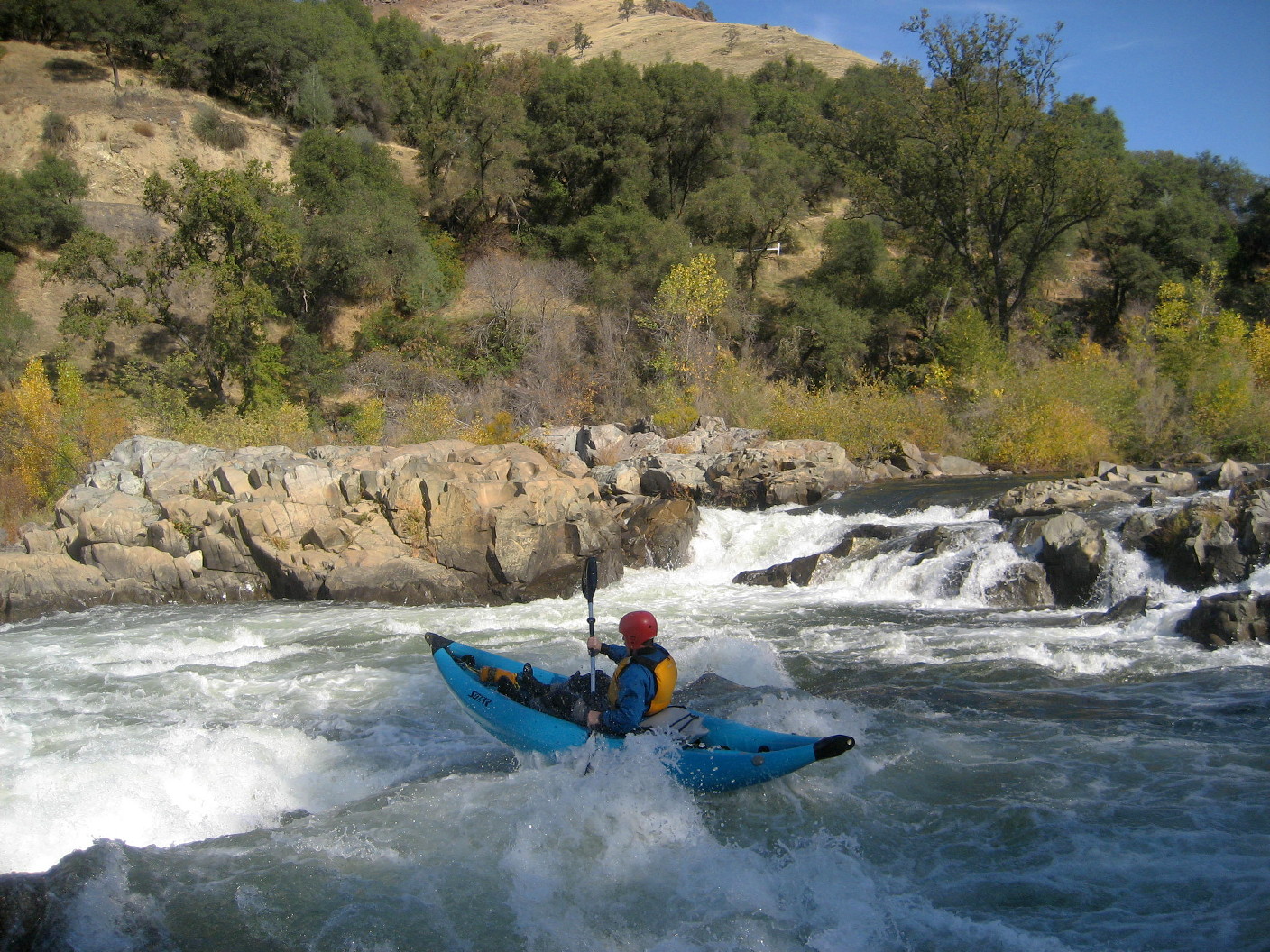
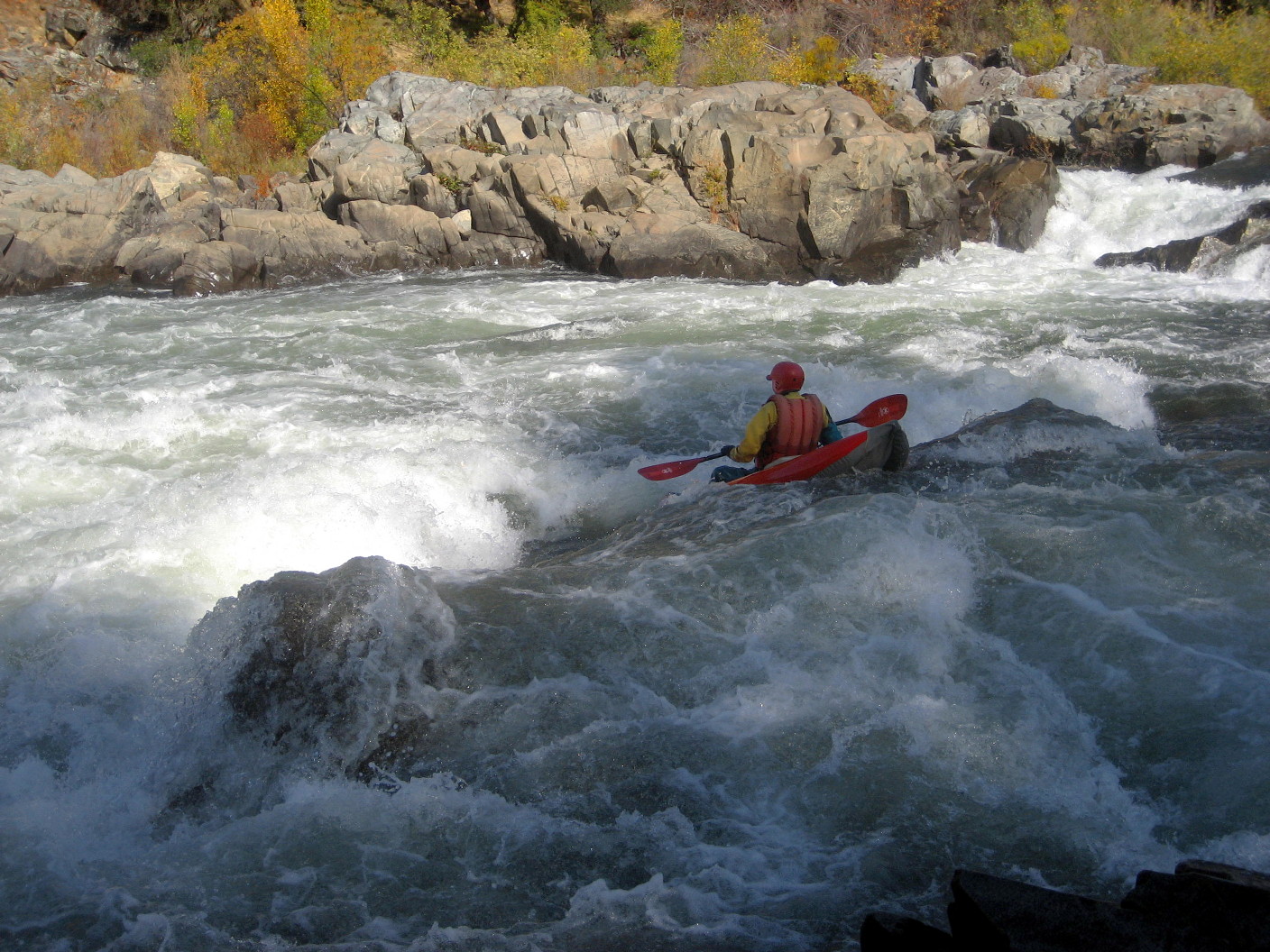
- Troublemaker, AKA S-Turn (class IV-), scout left.
The river enters a boulder garden, followed by a falls, with an S
channel on the far left. The rapid's name describes your route well.
At lower flows, the true path is narrow indeed. If you shade right,
a large diagonal wave tends to flip kayaks. If you go far left,
you end up in an eddy that is hard to exit. Precise placement into
the gut of the hole surfs you next to a big rock on the left below,
then thru a steep channel along Gunsight rock, where rafts often
end up wrapped. Advanced boaters might want to eddy left, then
ferry across the hole, exiting to the right of Gunsight rock.
In any case, the swim isn't too bad, but keep your feet up.
-
-
-
- An alternate kayak chute exists to the right of the main waterfalls,
but the bedrock below is badly undercut, and swimmers have been held
underwater for nearly a minute.
- 5.6
- Private campground on right, then a steel bridge. River access
should be legal, but is prohibited and enforced by the county.
Put in at this campground for the longest possible class II run.
- 5.8
- Coloma Lake, a long stretch with slow-moving current. Take-out is
prohibited; put-in access for non-commercial groups only, when doing
the Coloma to Lotus run (class II).
- 7.2
- Old Scary, class II-. This was formerly a class III rapid on the
right shortly above the highway 49 bridge, until high water detoured
the river leftward during the winter of 1982.
- 7.4
- Concrete bridge for highway 49. River access should be legal, but
at times has been prohibited and enforced by the county. Cheapskates
prefer to put in or take out here.
- 8.0 (0)
- Henningsen County Park in Lotus. Mileage (in parentheses) resets.
This is probably the best stopping and starting point for breaking up
this run into two sections. High parking fees, for public land.
Oddly, overnight parking is not allowed!
- 8.5 (.5)
- Lotus Ledge. Before the flood of 1997, this made a good surfing hole
on the left, but has been (temporarily?) eliminated.
- 9.0 (1.0)
- Camp Lotus, the nicest camping area in this vicinity. Usually
full on summer weekends, so make reservations well in advance.
Grass and tall sycamores make this a pleasant put-in spot.
-
- 9.1 (1.1)
- Barking Dogs Honking Geese (class II+). Named after Camp Lotus
neighbors. The river curves right and funnels into a nice hole,
then turns left and proceeds past a huge rock/hole on the right.
- 9.3 (1.2)
- Unnamed class II rapid with a fun blind traverse behind an island.
Many other unnamed class II- rapids.
- 10.6 (2.6)
- Current Divider (class II+). A rock island divides the flow.
The most fun route is to the right of the island, then left below.
Believe it or not, commercial rafts often get wrapped here.
- 11.1 (3.1)
- Highway Rapid (class II+). A long rock garden, very bony at low
flows (under 1100 cfs). The best route is just to the left of a
low brushy island, then slaloming around rocks until the slanting
left-to-right exit.
- 11.4 (3.4)
- Swimmer's Rapid (class II). Decaying estate on the left, willow bar
on the right. Greenwood Creek enters on the right below, marking
the end of the quiet zone. This makes an excellent take-out for
lightweight boats doing the Coloma to Lotus run, as an official BLM
access point. Carry up the trail downstream of Greenwood Creek
to a parking lot off highway 49.
- 11.6 (3.6)
- Turtle Lake, a long stretch with slow-moving current, mercifully
ended by...
- 11.9 (3.9)
- Cable Car Rapid (class II) and other unnamed class II rapids.
BLM land on both banks at mile 12.1, with composting toilet on the right.
This could be the best “wilderness” camping spot on this river,
with sandy beaches, oak trees, composting toilet, and few mosquitos.
Class II and II+ rapids continue without too much flatwater.
Many rock formations in this area contain Indian grinding holes.
Another picnic area with composting toilet is at mile 15.3 (7.3).
- 15.8 (7.8)
- Fowler's Rock (class III). Entrance to the Gorge, occurs after
the third sighting of the Lollipop tree on top of a distant hill.
Good time to put on your paddling jacket! The river bends left around
a gravel bar, then flows along a cliff on the left. Rafts are often
accidentally parked on a submerged boulder along a house-sized rock
on the right, but they can be avoided with a quick left-right slalom.
Go right of Fowler's Rock, the tall cabin-sized boulder ahead, then
pick a good slot (near center) in the diagonal boulder fence below.
-
- 16.1 (8.1)
- Upper Haystack Canyon (class II+). Big standing waves in a narrow
section of gorge. Not particularly difficult.
- 16.7 (8.7)
- Lost Hat (class III-). After a flat spot with cows and/or cowpies
on both banks, the river drops steeply into some big standing waves.
This rapid continues unabated into the one below. If you plan to
sneak Satan's Cesspool (not recommended at flows below 1500 cfs),
stay right; otherwise work left.
- 16.9 (8.9)
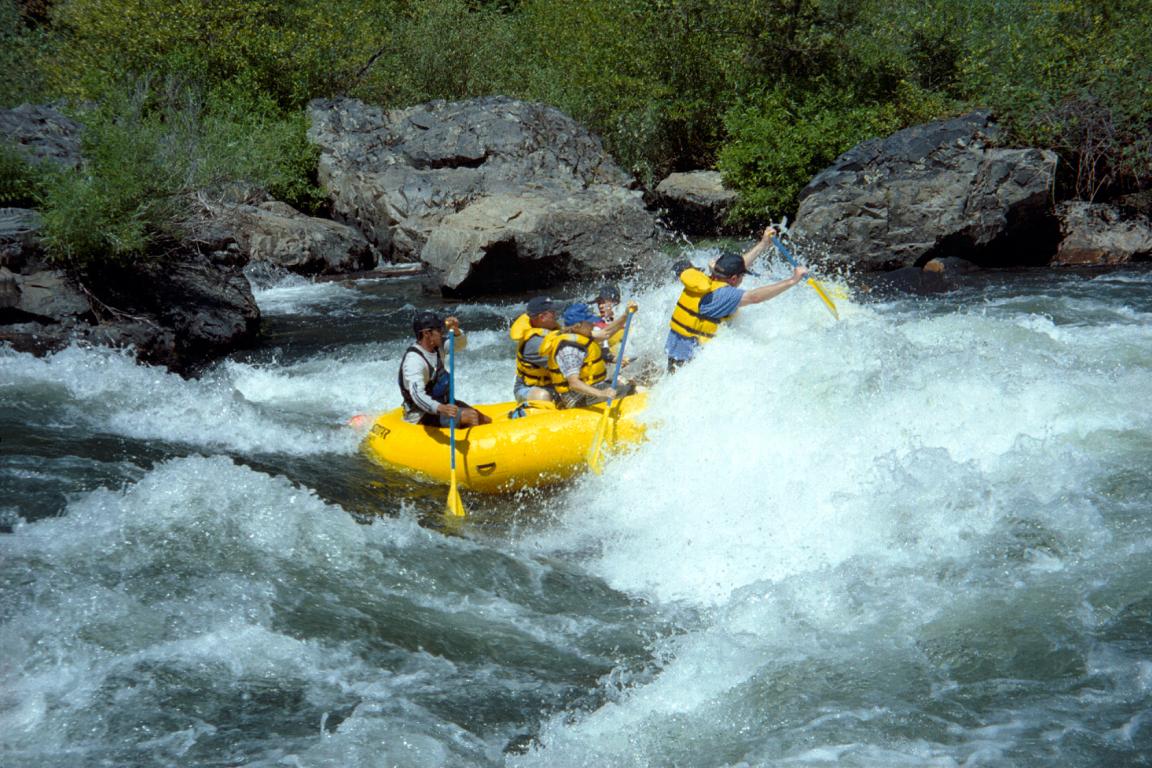
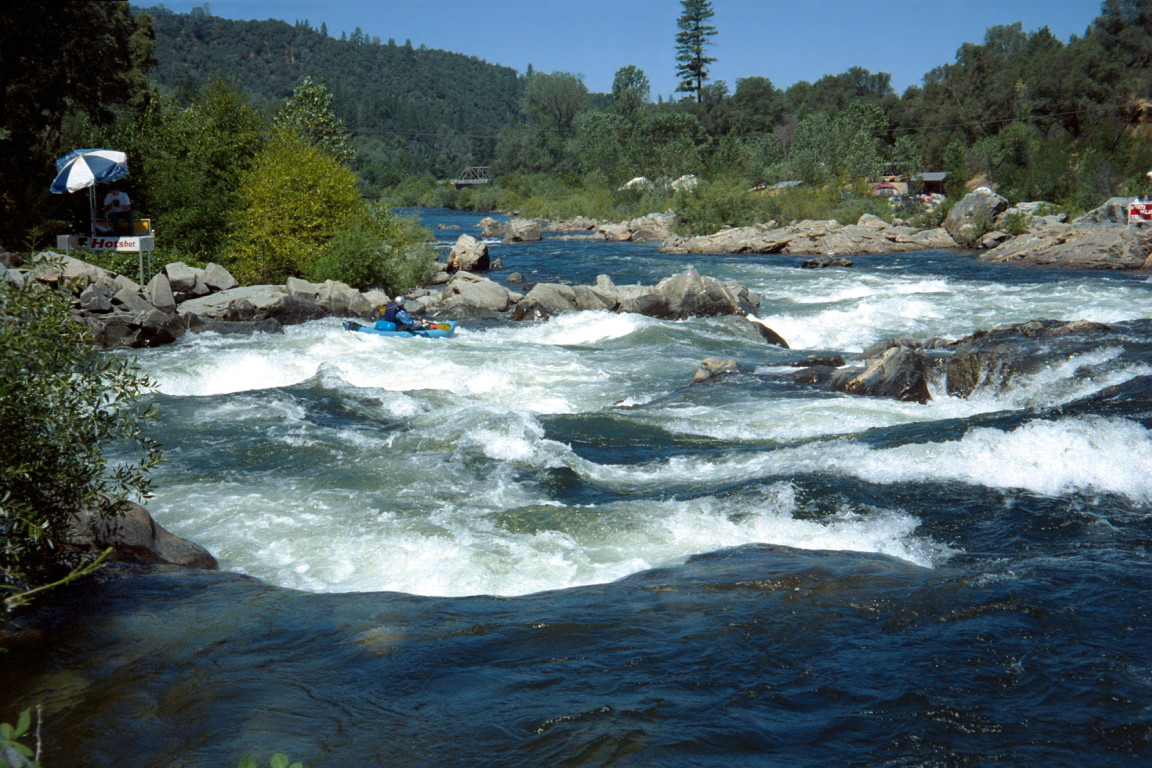
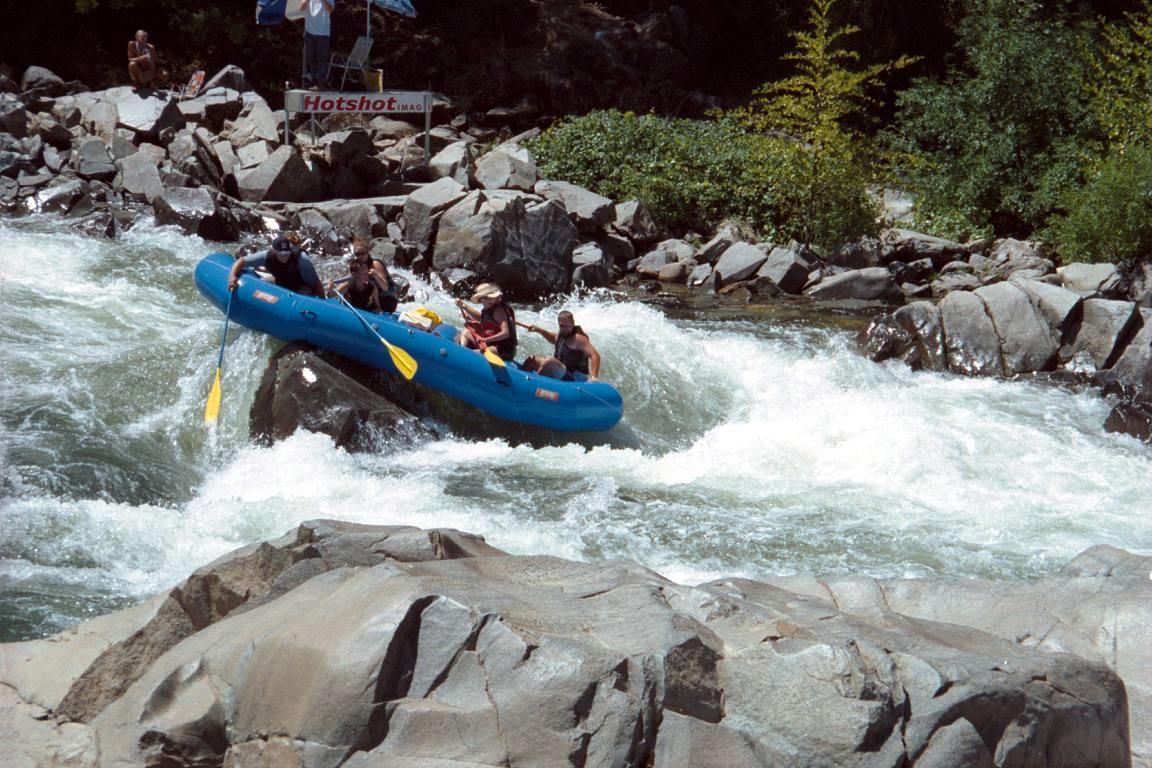
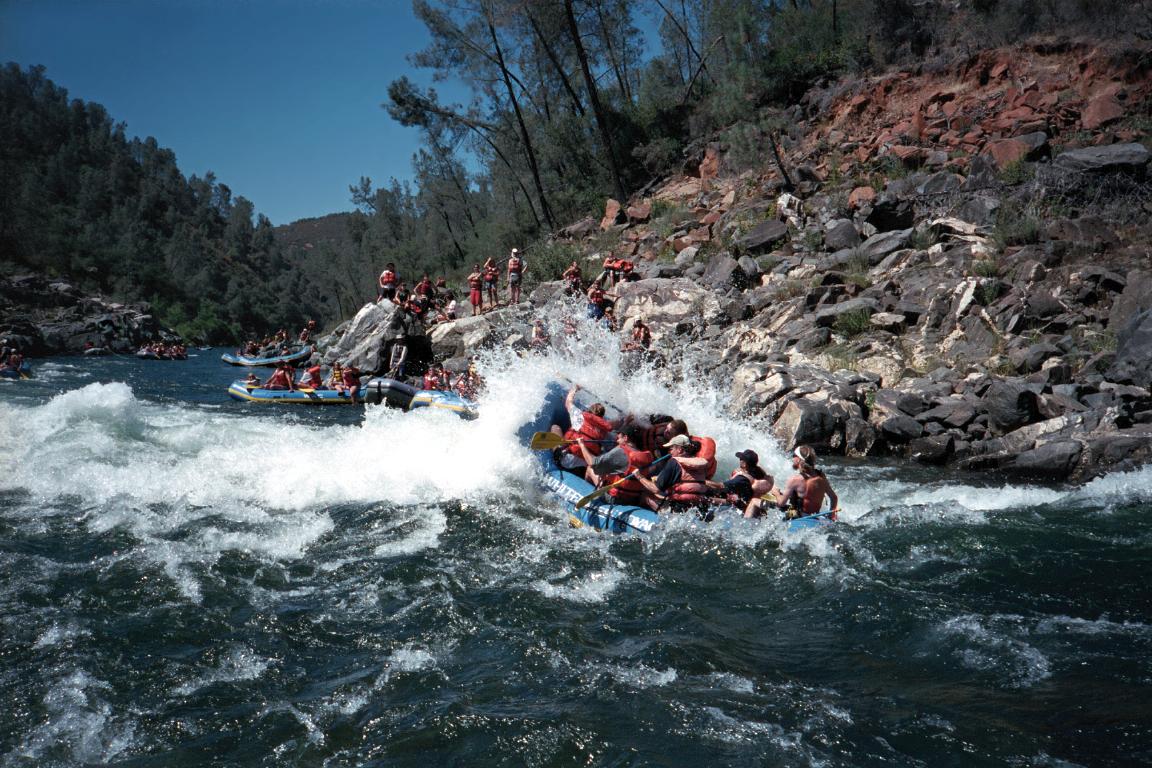
- Satan's Cesspool (class III+).
Photographers are usually stationed at several spots nearby.
An underwater rock cluster causes a hole and a large curling wave
at low or moderate flows. The safest way to kayak this rapid
is to eddy out left just above the main drop, then choose the
proper exit ramp near the left bank. If you swim, get back
in the boat fast, or swim into the lefthand eddy below, to avoid
getting bruised in Son of Cesspool just ahead. As a sneak route
at moderate flows, a narrow rocky slot is available to the right of
the central island, and might be the best choice for beginners,
since the eddy left of the curling wave can be tricky to catch.
-
-
-
- 16.95
- Son of Satan's, AKA Dead Man's Drop (class III). The best route,
whether boating or swimming, is just to the right of a submerged
rock in the center, but without smashing into the righthand wall.
If you're swimming and can't make the lefthand eddy with your boat
in tow, let go of your boat, because the swim to the left of the
submerged rock will probably kick your butt good. Hopefully some
strangers or your boating companions will retrieve your boat.
- 17.4 (9.4)
- Scissors (class III). After a short calm stretch, the river charges
over some diagonal bedrock ledges, along the left wall, then around
a cabin-sized rock on the right. To avoid swimming, always stay
perpendicular to the diagonal drops.
- 17.6 (9.6)
- Lower Haystack Canyon (class II+). Big standing waves in a narrow
section of gorge. A bit more difficult than the upper one.
-
- 18.2 (10.2)
- Bouncing Rock (class III). Most of the current smashes into a rock
on the right, then pours into a large flippy hole. Because the swim
below is shallow and rocky, consider sneaking this rapid by ferrying
left continuously from the outset (class II+).
- 18.4 (10.4)
- Triage, AKA Pre-Op (class III-). Big standing waves with rocks and holes along
the banks.
- 18.5 (10.5)
- Jumping Rock, a tall boulder with small ledge that offers a spot
for the brave to leap about 20'into a deep pool.
- 18.6 (10.6)
- Hospital Bar (class III). After a small boulder garden, most of the
current drops right over a boulder bar into a fast channel along the
right bank. A diagonal hole at the bottom is best run on the left,
but you can ham it up for photographers by running further right,
where a flip is possible. Named for a hospital tent set up during
the gold rush.
-
-
- 18.8 (10.8)
- Recovery Room (class III-). When the reservoir is down, the hole
at the bottom is a miniature version of Hospital Bar. But when the
reservoir is full, it is class II at most.
- 19.3 (11.3)
- Surprise (class II-III depending). At the top of a wide gravel bar,
the river bends left into a fast chute. Late in the summer, boaters
get surprised as this rapid uncovers. You can sneak it on the right,
or run over the big center rock into a hole, if you're brave.
When the reservoir level is high, tow services are available for a fee.
- 19.5 (11.5)
- Seldom Seen (class II+ or underwater). A diagonal rock fence from
left to lower right provides several route choices.
- 20.5 (12.5)
- Take out just before or shortly after Salmon Falls bridge, depending
on where you parked. Toilets are available in both places.
Shuttle Directions
To reach take-out at Salmon Falls bridge,
go east on highway 50 uphill from Sacramento.
Past the top of a long grade, in the midst of shopping malls,
exit and turn north on El Dorado Hills Blvd.
After 4.2 miles, at a traffic light, cross Green Valley Rd,
where the name changes to Salmon Falls Rd.
Continue 5.9 more miles to a bridge across the river.
You can park for free before the bridge, if there is space,
or for a fee in the lower or upper parking lots after the bridge.
Warning: break-ins occur in these parking lots, when not patrolled,
so don't leave anything valuable in your vehicle.
To reach the Coloma put-ins from there, continue uphill 5.7 miles on Salmon Falls Rd.
In the hamlet of Pilot Hill, turn right on Salmon Falls Cutoff Rd.
Almost immediately, turn right on highway 49 south.
Continue 7.6 miles to the town of Coloma.
Henningsen Park (fee area) is about a mile downstream to the right,
and Camp Lotus is another mile or so further.
Other private campgrounds offer put-in access for a fee.
To reach the Coloma put-ins or take-outs from highway 50,
continue east and uphill to the Shingle Springs exit.
Shortly after crossing to the north of the freeway,
turn sharp right on North Shingle Rd.
Although it seems like the same highway,
after 3.8 miles this becomes Green Valley Rd.
In another .5 mile the road bears left at a Y and becomes Lotus Rd.
Continue another 6.8 miles to the town of Coloma.
To reach the Chili Bar put-in from Coloma,
take highway 49 south past Marshall Gold Discovery park.
Where highway 49 turns sharp left, go straight uphill on Cold Springs Rd.
(You can also take highway 49, but it is curvy and slow.)
In 2.7 miles at a 4-way intersection, turn left on Gold Hill Rd.
In .9 mile at a T intersection, turn right on highway 49.
In 2.8 miles near a restaurant, turn sharp left downhill on highway 193, Georgetown Rd.
After 2.3 miles of steep descent, cross the river and turn left into Chili Bar Resort.
Chili Bar Resort is privately owned (2010) and charges parking and put-in fees.
To find nearby food and lodging, type Colfax into the box and click Search.
|
|
Creeks Navigation
Home
Recommended Runs
Map of Rivers
Alphabetic Index
Alphabetic Table
Text Search
Sponsored Links
|